Pop-Up Island in Próspera ZEDE: Founding the Regenerative District in Roatán
A New Model of Economic and Territorial Design Emerges in Roatán
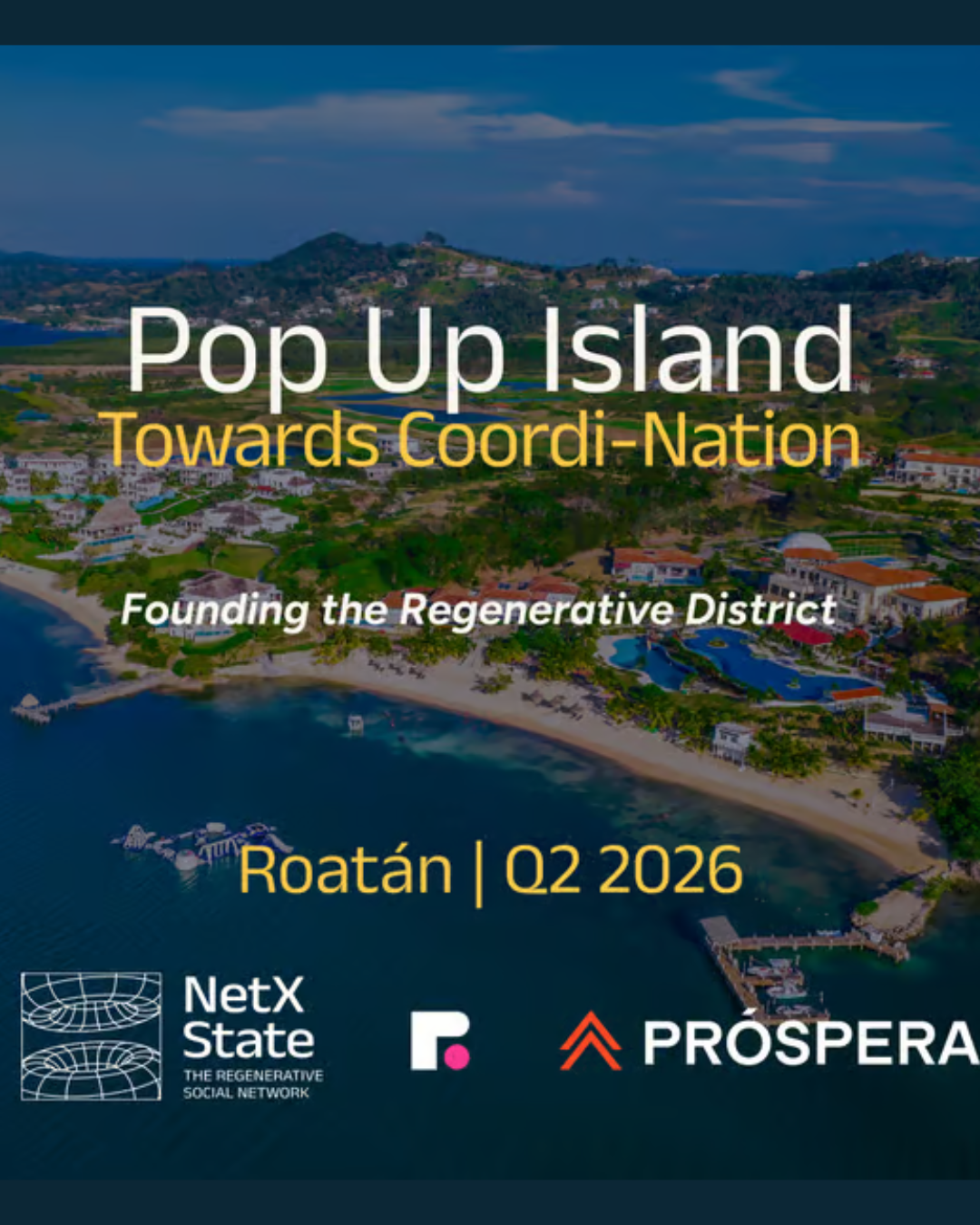
The upcoming Pop-Up Island gathering in Próspera ZEDE represents a new chapter in how territories are designed, governed, and financed in the 21st century. Taking place in Roatán from May 18–26, 2026, the initiative brings together a curated group of global builders, investors, and system designers to co-create what is being defined as the first Regenerative Impact Special Economic Zone (RISEZ). Rather than functioning as a traditional conference, the program is structured as an intensive founding sprint where governance frameworks, capital structures, and institutional systems are actively designed and tested in real time.
The event positions Roatán not only as a Caribbean destination but as an experimental ground for next-generation economic systems. Through a combination of legal innovation, digital infrastructure, and participatory design, participants are tasked with building a replicable model that connects capital flows with measurable regenerative outcomes. This reflects a broader global shift in which territories are no longer competing solely on tourism or tax advantages, but on their ability to host new forms of coordinated economic evolution.
Designing the First Regenerative Impact Special Economic Zone (RISEZ)
At the core of Pop-Up Island is the creation of the RISEZ framework, a system designed to make regeneration financially viable, technologically scalable, and institutionally enforceable. The model integrates experimental governance structures compatible with ZEDE frameworks, Web3-enabled coordination tools, and hybrid fiat–crypto financial rails. This combination is intended to allow capital to flow into projects that generate measurable ecological, social, and economic value, rather than extractive returns alone.
The founding process focuses on establishing a complete institutional architecture, including governance rules, impact measurement systems, and investment mechanisms that can be replicated in other jurisdictions. Within Próspera ZEDE, this becomes a live pilot environment where legal clarity and regulatory flexibility allow participants to move from conceptual frameworks to operational systems. The ambition is not theoretical innovation, but the creation of functioning infrastructure that can be exported globally as a new category of territorial design.
A Founding Sprint, Not a Conference
Unlike traditional policy or innovation gatherings, Pop-Up Island is structured as a high-intensity working sprint where participants are directly responsible for producing institutional outputs. Over the course of the program, teams move through a structured arc that begins with alignment and sense-making, continues into governance and capital design, and culminates in formal commitments and founding agreements. Each phase is designed to progressively transform ideas into executable systems supported by legal and financial structures.
The methodology blends systems thinking, participatory design, token engineering, and embodied collaboration practices. This includes structured co-creation sessions, conflict-resolution frameworks, and shared decision-making processes that ensure outputs reflect collective intelligence rather than top-down design. The result is a working environment where governance is not discussed abstractly but actively built, tested, and refined by the participants themselves.
From Design to Execution: Building Institutional Infrastructure
By the conclusion of the sprint, participants aim to produce a fully structured founding package for the Regenerative District. This includes a governance charter defining rights and decision-making structures, an impact accounting system capable of tracking multi-dimensional value creation, and a regenerative capital framework linking investment directly to verified outcomes. In parallel, a “Regen Twin Desk” is developed as an operational gateway connecting the district to global entrepreneurs, allowing external projects to interface with the system.
The Twin Desk is particularly significant as it transforms the district from an isolated experiment into a functional node within a global network of innovation. It enables startups and investment vehicles to operate across jurisdictions while remaining connected to Próspera’s legal and financial infrastructure. This dual-layer structure—governance design paired with operational access—ensures that the system is both conceptually robust and immediately usable.
Roatán as a Living Laboratory for Regenerative Innovation
The choice of Roatán as the host location reflects a broader evolution in how the island is positioning itself globally. Through initiatives like Pop-Up Island, Próspera ZEDE is increasingly being recognized as a testing ground for new models of governance, investment, and economic coordination. This includes frameworks that integrate regenerative economics, digital governance platforms, and cross-border capital flows into a single operational environment.
Rather than functioning solely as a tourism-driven economy, Roatán is being reframed as a jurisdiction where global talent can actively design and deploy new institutional systems. This positions the island within a growing global movement toward experimental governance zones, where innovation is not constrained by traditional regulatory limitations but enabled through structured legal flexibility and international collaboration.